Promesse: Reading Young Footballers from What They Did
Which under-21s become regulars? An engine tested on seasons it never saw, next to market value and a coin flip
- Context
- Personal project · the sequel to Tactical Patcher
- Role
- Solo: data, models, the desk and the stadium
- Team
- Solo
- Period
- 2026
- Galleries
- Player & Match Modelling, Tactical Analysis
The problem
A young player's market value is the trade's opinion, and it is hard to beat. I wanted to know how far match records alone go: minutes, the level of the matches, age, moves. And I wanted every claim tested the honest way, on seasons the model never saw, against a plain baseline, with the failures written down.
What I built
- One question for each under-21 across 31 first divisions: will he be a regular in one of them within three seasons? The engine reads only what happened. Ratings and market values are benchmarks to compare against, never taken as inputs.
- Every input has to pass a point-in-time test: could it have been known on the day?
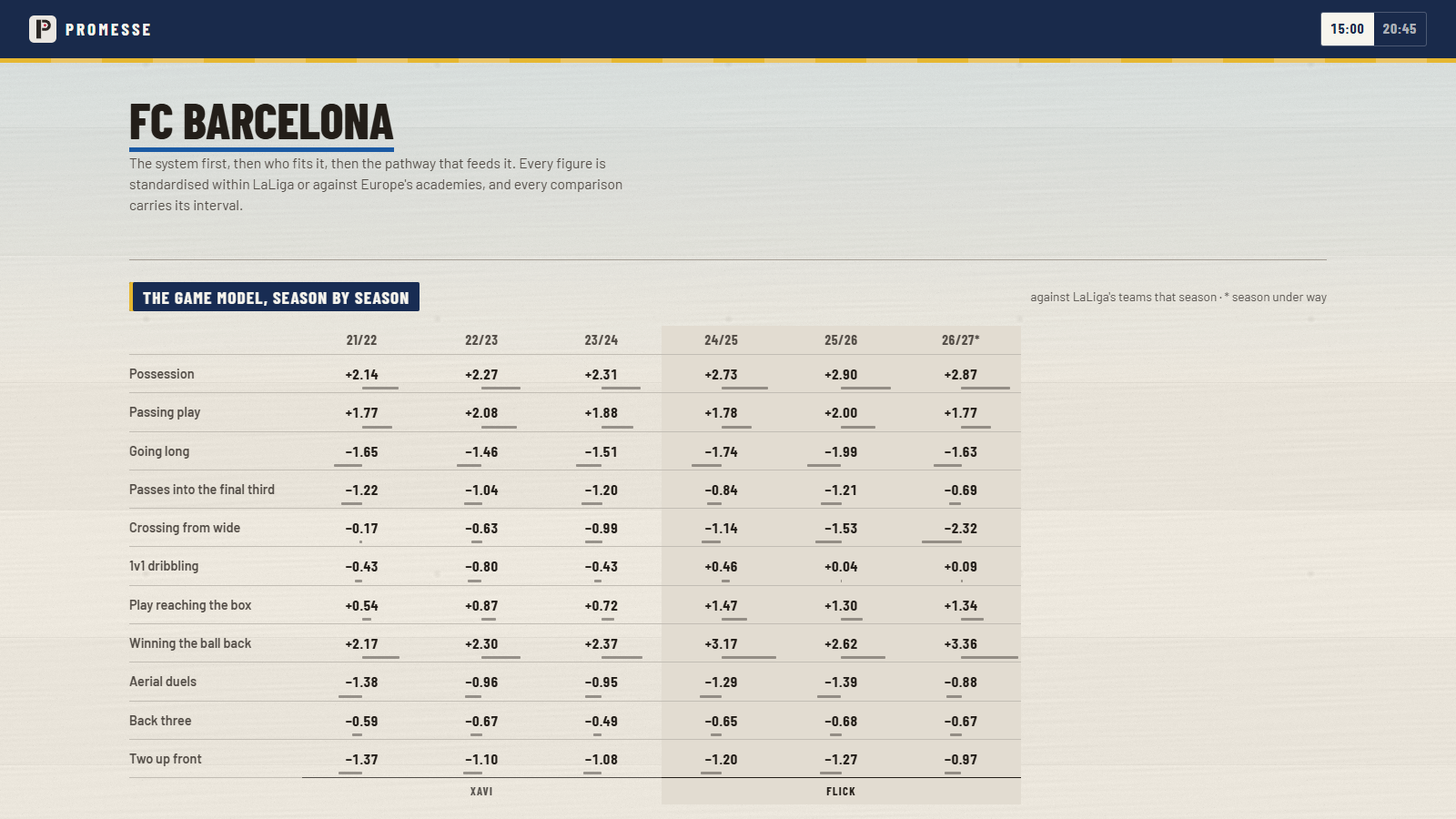
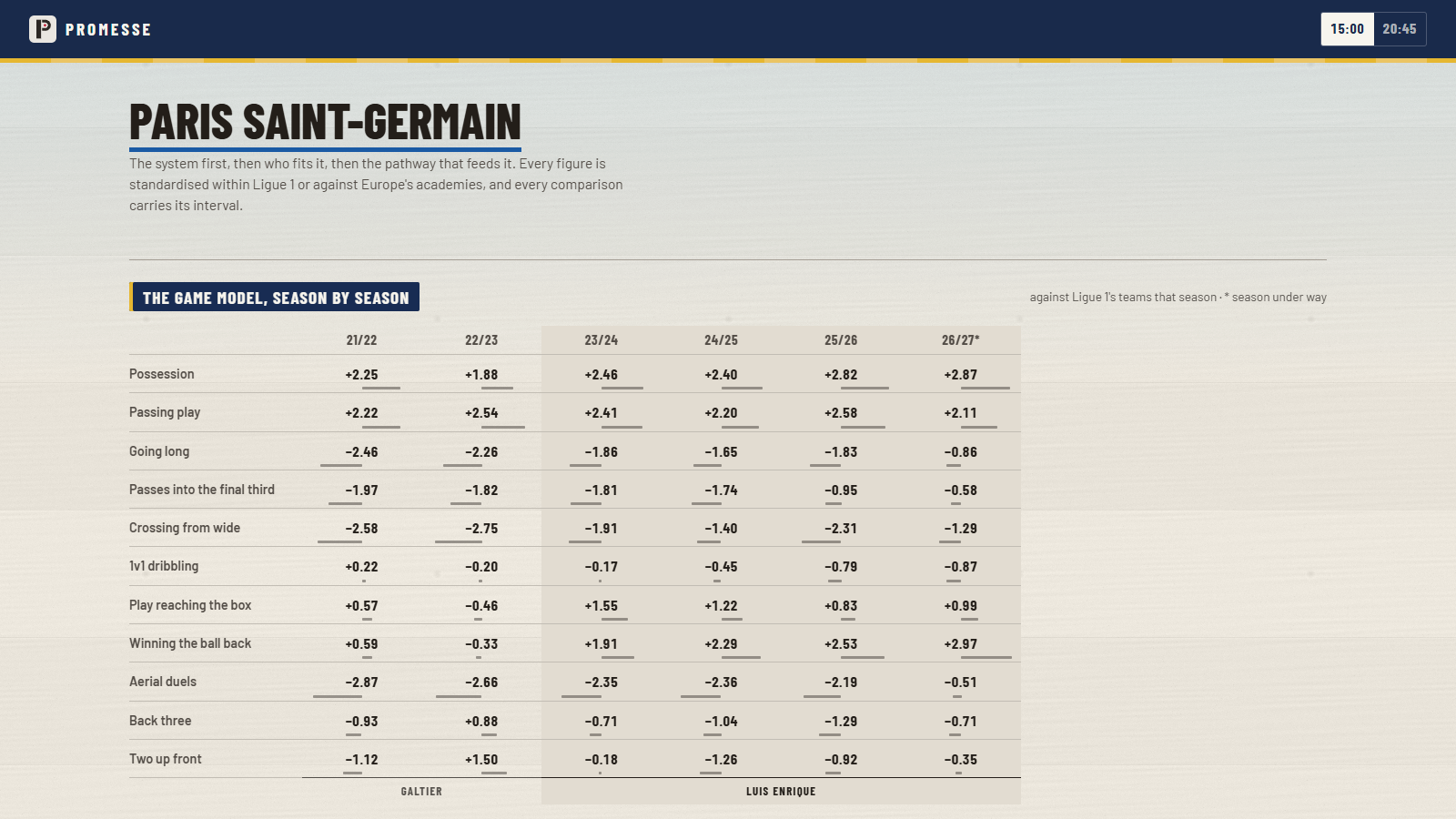
- A tactical layer on top: how a team plays, whether a coach carries his style from club to club, what a player does inside his team and beyond his system, how he would fit elsewhere. Five of six tests passed; the sixth (which systems grow young players fastest) did not, and our desk is honest about it.
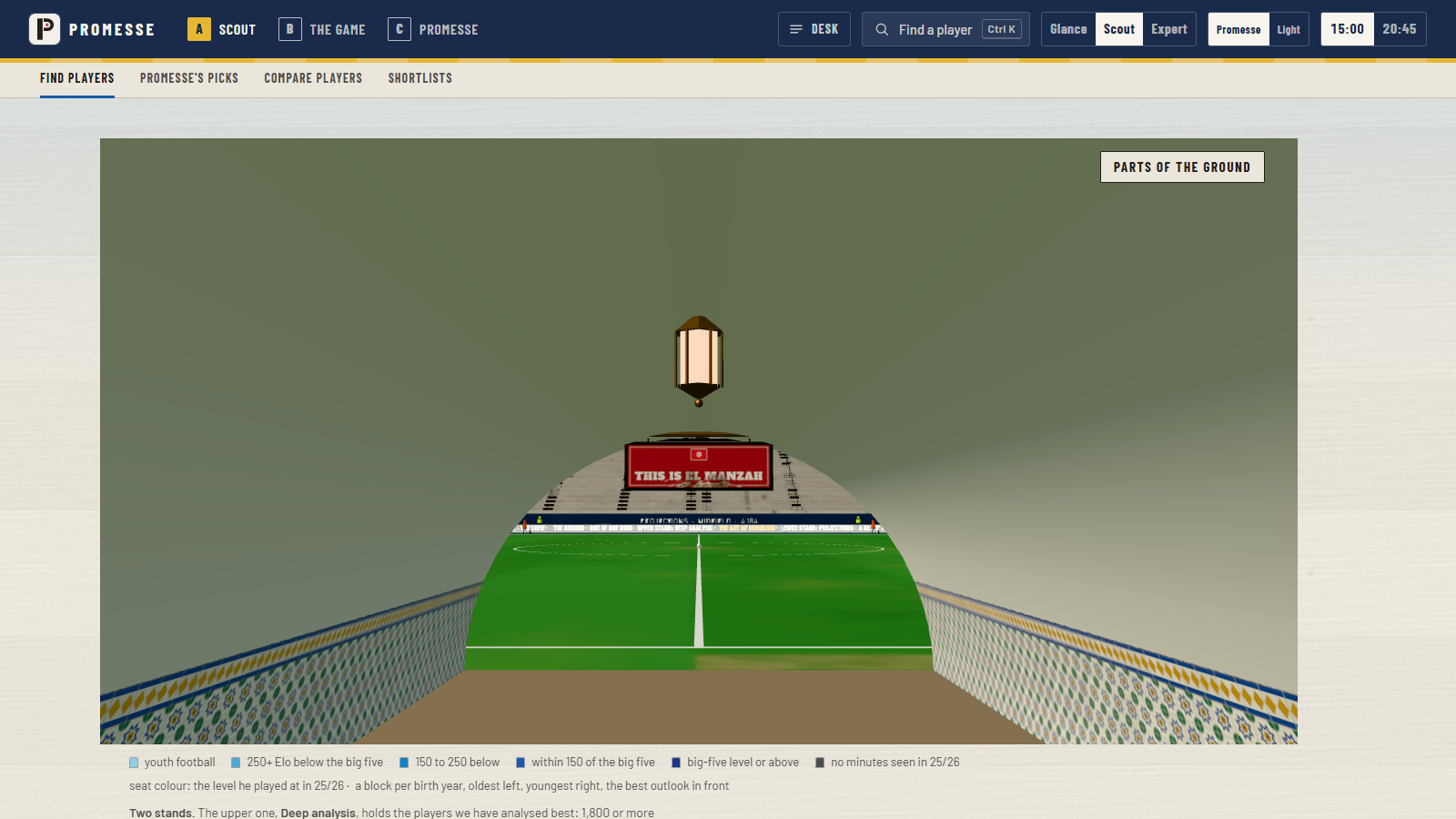
- The Scout Desk: one page per player with every number and its source, a Scoreboard that keeps every test and baseline, and a stadium (The Ground) where each seat is a player.
- Two club deep dives are built on the 1.0 release: FC Barcelona and Paris Saint-Germain.
Inside the decisions
Ranges that hold, and the sharper model that did not
A projection of minutes is a guess; a range is a promise. After calibration, the 80 % ranges held 80.3 times in 100 on unseen seasons.
A sharper version, ProProjection v2, held 77.0 in the group with the most evidence, against the 80 aimed for. It did not pass, so ProProjection stays, and the failure is in the repo.
The outcome
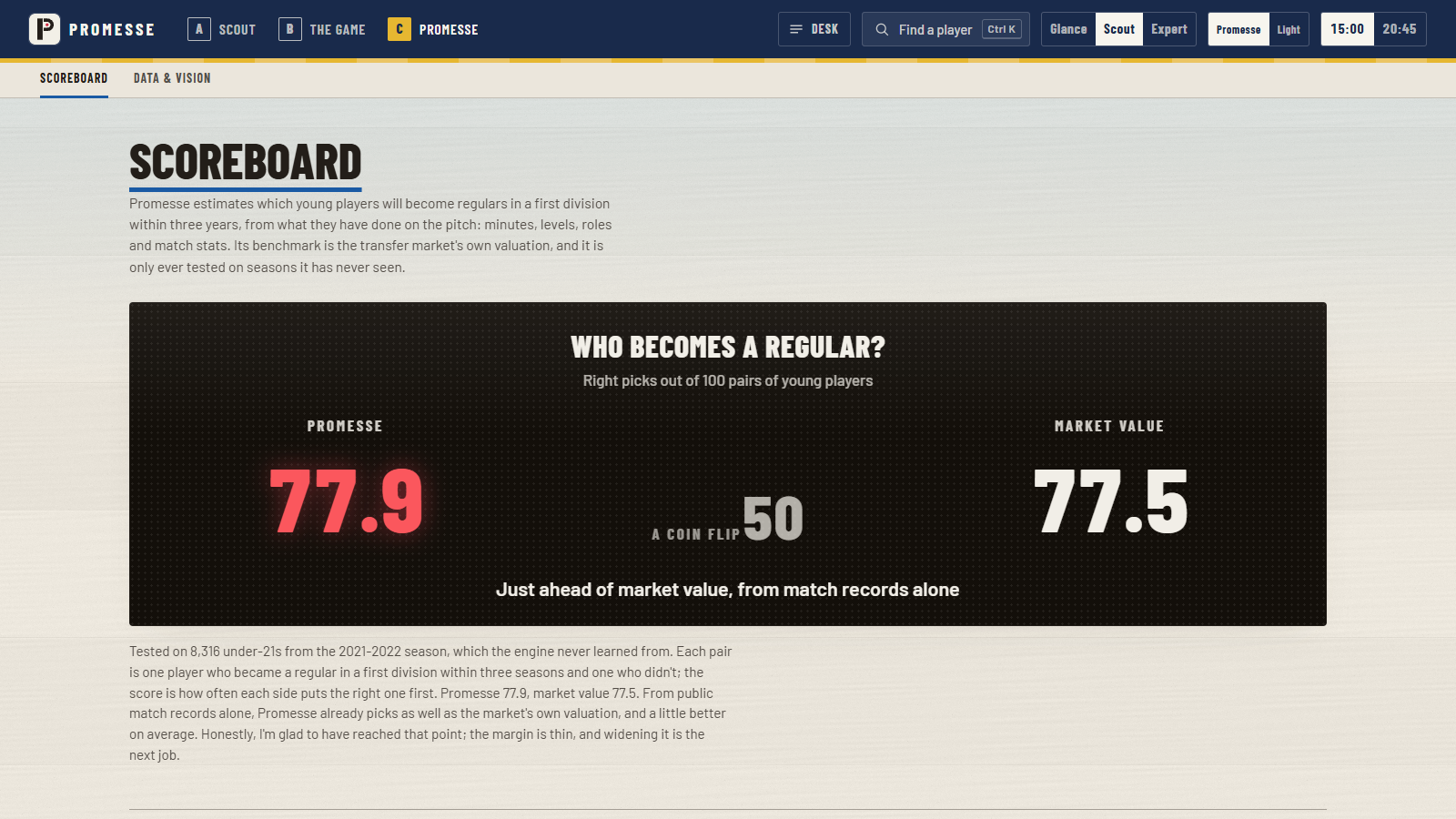
On the one test on the unseen 2021-22 season, the engine puts the right player first in 77.9 of 100 pairs of young players; market value does in 77.5, a coin flip in 0.5, Just ahead of market value on average, but the gap is small enough that its 95 % range crosses zero, so it is level with the market, not a proven win. The code and the method are open; the data behind them is privately collected, so a club or a researcher sends a question and gets the results back, never the rows.
What would come next
- The 2024 cohort is the next clean judge, after the 2026/27 season: the earlier test seasons are spent.
- Run it on a club's own data, through the data contract the repo ships, to see what that data can add to what public records read.
Stack
What it proves
The code and method are open. The data is not: open datasets are named in the README, the rest is privately collected data, and no table of players or matches is published.